
Tools
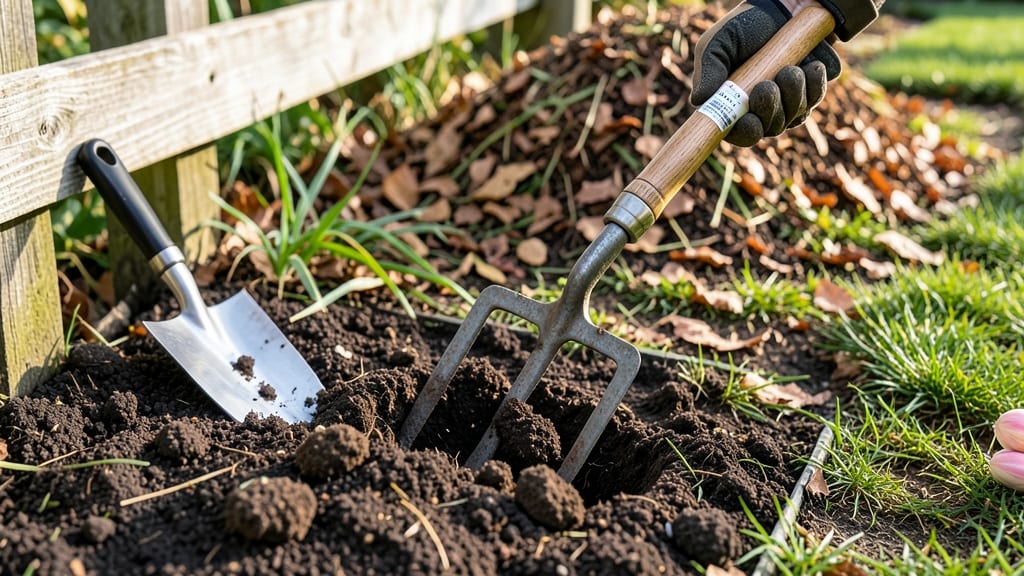
A garden fork has versatile uses beyond digging—it aerates lawns, lifts sod, extracts weeds by the root, and even mixes compost without disturbing surrounding soil, making it perfect for tasks requiring precision and control.
A garden fork's four sturdy tines and angled design give it a mechanical advantage over trowels or shovels, letting you work deeper with less effort. 🔥 Unlike a trowel that slices through soil, the fork's prongs lift and separate without flipping everything upside down—a game-changer for lawn aeration or breaking up clay without compacting it further.
I've used mine to gently loosen roots around shrubs without damaging stems, which is impossible with a shovel's flat blade.
Beyond soil work, this tool shines in unexpected ways: prying up sod for lawn repairs, harvesting potatoes without bruising them, or even mixing heavy compost piles. The leverage lets you tackle stubborn tasks like removing tree roots or lifting mulch without straining your back.
For me, the fork's real magic happens when I need to work between plants without disturbing their roots—something no other tool handles as cleanly.
💡 In This Article
- How a Garden Fork Outperforms a Trowel in Soil Work
- Unexpected Garden Tasks Where a Fork Saves Time
How a garden fork outperforms a trowel in soil work
The garden fork’s four sturdy, widely spaced tines (typically 6-8 inches long) create a mechanical advantage that trowels simply can’t match. When you push the fork into soil, the tines act like levers, distributing force downward while the handle provides 2-3 times more leverage than a trowel’s narrow blade.
This lets you penetrate 12-18 inches deep with minimal effort—ideal for breaking up compacted clay without the arm fatigue of a shovel.
Unlike a trowel that slices through soil, the fork’s design lifts and separates rather than flipping. When aerating lawns, the tines create ¼-inch to ½-inch holes while leaving surrounding soil intact, which is critical for root growth.
In clay soil, the prongs wedge between particles, creating micro-channels that improve drainage—something a trowel’s flat edge can’t achieve without compacting further. The fork’s angled shaft also lets you work at a 45-degree angle, accessing tight spots between plants or along fence lines where trowels get stuck.
For sod removal, the fork’s leverage is unmatched. By driving the tines under the sod in 4-inch sections, you can lift entire strips cleanly, preserving the grass’s root structure for reuse. This precision is impossible with a shovel, which tends to tear roots and leave uneven edges.
The fork’s ability to grip and lift also makes it superior for extracting weeds with deep taproots, like dandelions or quackgrass, without breaking the crown—whereas a trowel might snap the root, causing regrowth.
Clay soil presents a classic challenge where the fork shines. Its tines act like wedges, splitting hardpan layers without the need for heavy machinery. I’ve used mine to break up 6-inch-thick clay crusts by driving the fork in at 3-inch intervals, then twisting to widen the cracks.
The result? Soil that crumbles easily when amended with compost—something a trowel would only scratch the surface of. The fork’s design also prevents soil from sticking to the tines, unlike a shovel’s flat blade.
Even in loose, sandy soil, the fork’s advantages appear. Its tines aerate without displacing topsoil, which is critical for seedbeds. When transplanting, the fork’s precision lets you dig around roots without damaging them—a task where trowels often cause unnecessary trauma.
The tool’s versatility extends to mixing amendments like compost or sand into existing soil, creating a more uniform blend than a trowel’s shallow cuts.
What most gardeners don’t realize is how the fork’s weight distribution reduces back strain. The balanced design lets you use your body weight to drive the tines down, while the handle’s ergonomic curve (often 18-24 inches long) provides better leverage than a trowel’s short handle.
This makes it the tool of choice for tasks requiring repetitive deep work, like preparing vegetable beds or renovating lawns.