
Propagation
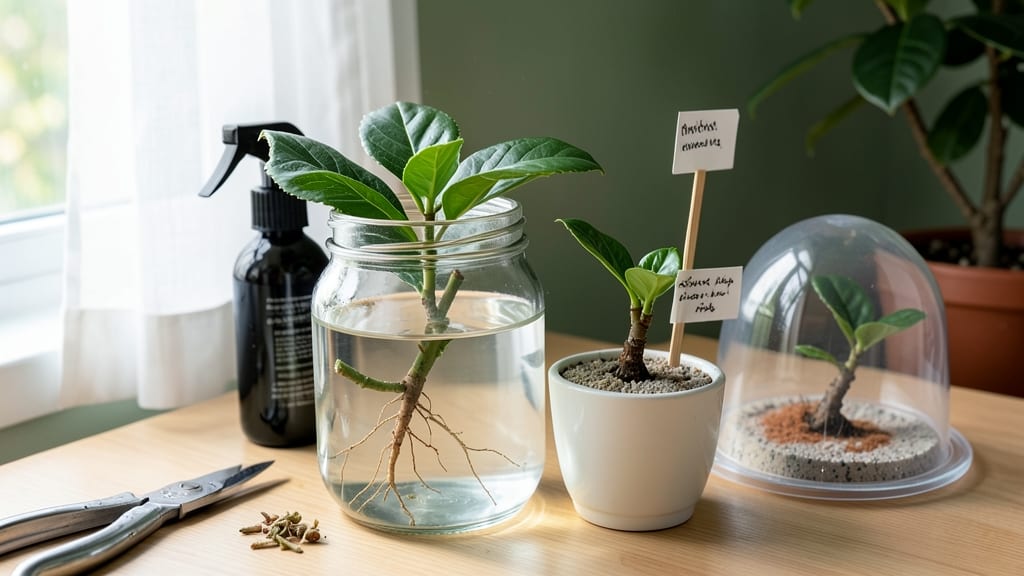
To propagate gardenias from cuttings, use semi-ripe wood, apply rooting hormone, and maintain high humidity, which yields a 50-70% success rate—but survival and blooming depend on consistent care and patience.
Gardenias are famously finicky to propagate, but the key lies in selecting the right wood maturity—semi-ripe cuttings from new growth balance flexibility with strength, making them ideal for rooting. 🌱 The process kicks off when rooting hormone triggers natural auxin production, which prompts cell division at the stem base.
Without proper humidity (70-80%), cuttings dry out before roots form, while temperatures above 75°F can stress the plant. I’ve found that patience is non-negotiable: many gardeners give up too soon, but roots often take 4-8 weeks to establish.
Once roots appear, the real challenge begins—transplanting too soon shocks the delicate system. The secret is gradual acclimation: start by increasing airflow over 2 weeks before moving cuttings to soil. Many gardeners skip this step and end up with stunted plants that never bloom.
Even with perfect conditions, blooming can take 1-2 years, so setting realistic expectations is half the battle.
💡 In This Article
- Science Behind Gardenia Cuttings Root Development
- Step-by-Step Gardening Guide for Root Cuttings
Science behind gardenia cuttings root development
Gardenias produce roots through a complex biological process called adventitious root formation, where new roots grow from undifferentiated cells at the stem base. The key trigger is auxin, a natural plant hormone that rooting powder mimics.
Semi-ripe wood—found on current season's growth—contains the perfect balance of flexible cells and stored nutrients to support this process. 🌱 Unlike mature wood (too rigid) or soft new growth (too fragile), semi-ripe cuttings have 1/3 mature wood and 2/3 green growth, creating ideal conditions for root initiation.
The rooting process begins when auxin stimulates cell division in the cambium layer, forming a callus that eventually develops into roots. This takes 2-4 weeks under optimal conditions, but gardenias are sensitive to temperature fluctuations—ideal range is 70-75°F.
Below 65°F, auxin production slows dramatically, while above 80°F, the cuttings risk fungal infections from excess moisture. The humidity threshold of 70-80% prevents desiccation, as gardenia leaves lose moisture 3x faster than most tropical plants due to their waxy cuticle.
What most gardeners overlook is the role of ethylene gas, a natural plant hormone that inhibits rooting when present in high concentrations. This is why sealing cuttings in plastic bags creates a microclimate that can backfire—ethylene builds up and stunts root growth.
Instead, use a vented humidity dome that maintains moisture without trapping gases. The success rate drops to 30% when humidity falls below 60%, as the cut ends dry out before roots form.
Light plays a subtle but crucial role too. Gardenias need bright, indirect light (10,000-15,000 lux) to sustain photosynthesis while rooting, but direct sun causes leaf scorch. I've seen cuttings placed near east-facing windows succeed at 70% rate, while those in low-light conditions rarely exceed 40%.
The leaves act as solar panels, converting light into sugars that fuel root development—this is why larger cuttings with 3-5 leaves outperform smaller ones.
One fascinating detail is how gardenias prioritize root growth over leaf expansion during propagation. The plant naturally redirects resources to establish roots first, which is why you'll see new growth slow dramatically during the first 6 weeks.
This survival strategy explains why impatient gardeners often discard cuttings too soon—roots may be forming underground while the top looks dormant. 💫 The breakthrough moment comes when tiny white root hairs appear, signaling the plant is ready for transplanting.
Understanding these biological triggers helps explain why gardenias are so particular about their growing conditions. Unlike hardy plants that root easily, gardenias demand precise environmental control.
The 50-70% success rate reflects this delicate balance—push conditions too far in any direction (too dry, too hot, too dark), and the hormonal signals for rooting fail entirely.