
Tools
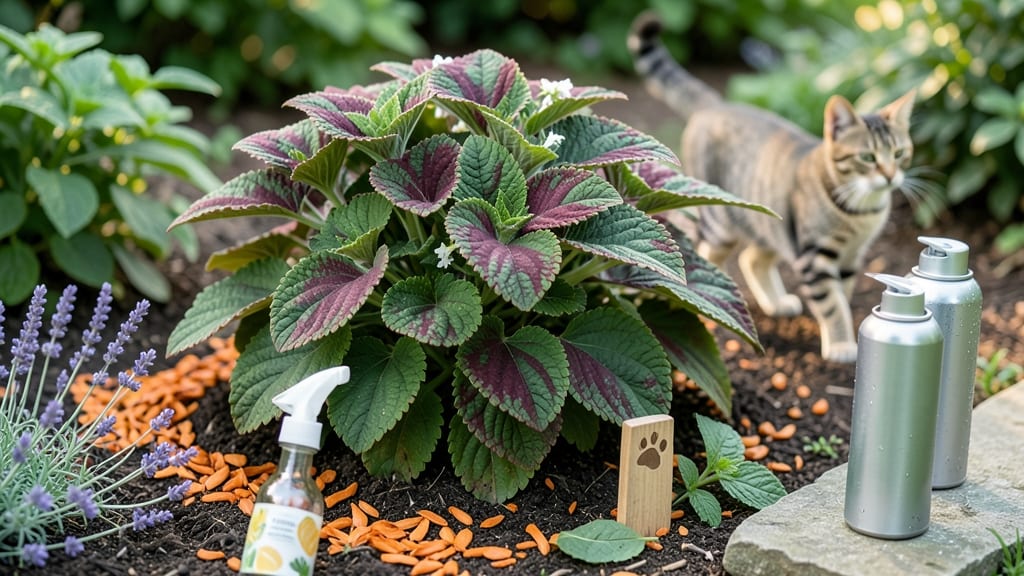
To repel cats from your garden, use natural deterrents like citrus peels, coffee grounds, or strong-smelling herbs such as rosemary and lavender. Planting cat-repelling foliage like rue or coleus also creates a long-term barrier without harming pets or wildlife.
Cats have sensitive noses that react strongly to pungent scents and textures they dislike, like the sharp aroma of citrus or the rough feel of prickly plants. 🔥 The key is combining visual and olfactory deterrents—cats avoid areas that smell unpleasant or look uninviting.
For example, scattering coffee grounds near garden edges disrupts their scent-marking habits, while rue's bitter foliage makes them think twice before digging. I've found that rotating deterrents seasonally (like fresh herbs in summer, vinegar sprays in winter) keeps them guessing without relying on harsh chemicals.
What's interesting is how cats' territorial instincts work against them—once they associate a scent or plant with discomfort, they'll avoid the entire area. The best solutions are those that create a multi-sensory barrier: something they can see, smell, and physically avoid.
For instance, coleus with its fuzzy leaves looks unappealing, while lavender's strong fragrance makes them prefer other spots for their "business."
💡 In This Article
- Why Cats Avoid Certain Plants and Scents
- Best Natural Cat Repellents for Gardens
Why cats avoid certain plants and scents
A cat's sense of smell is 14 times stronger than ours, making them hyper-sensitive to volatile organic compounds (VOCs) found in many plants. 🌿 Essential oils like citronella and eucalyptus contain monoterpenes, which cats perceive as overwhelming and toxic—even though they're harmless to humans.
Their brains interpret these scents as threats, triggering avoidance behavior through their Jacobson's organ, a specialized olfactory system that processes pheromones and strong aromas.
The texture of plants plays a crucial role too. Cats instinctively avoid anything that feels rough or prickly to their sensitive paws. 🐾 Rue, for example, has jagged leaves that create an uncomfortable barrier, while coleus varieties with fuzzy foliage disrupt their digging habits.
This physical deterrent works alongside scent—cats won't risk stepping on surfaces that feel threatening. Even the visual appearance matters: plants with sharp edges or unnatural growth patterns (like Ornamental Marigolds) make gardens look less appealing for territorial marking.
Territorial instincts amplify these reactions. Cats spray urine to claim areas, but strong scents like vinegar or citrus make them think twice—these smells mask their own scent markers. 🔥 The key is creating an environment where every sense (smell, touch, sight) tells them to stay away.
For instance, lavender's linalool compound isn't just unpleasant—it disrupts their natural communication chemicals, making them avoid entire zones.
Seasonal variations affect what works best. In summer, herbs like rosemary and thyme release stronger oils when warm, while winter requires more concentrated sprays. 💫 The science shows that cats learn through repetition: after 3-5 exposures to an unpleasant scent or texture, they'll permanently avoid that area.
This is why rotating deterrents (like fresh herbs vs. dried coffee grounds) maintains effectiveness over time.
Behavioral studies reveal another fascinating detail: cats associate certain scents with discomfort from past experiences. If a cat once had an unpleasant reaction to a plant (like catnip's cousin, Nepeta), they'll generalize that avoidance to similar-looking plants.
This is why creating a consistent multi-sensory barrier—combining scent, texture, and visual cues—is the most reliable method for long-term repelling.
What most people don't realize is how cats' whisker sensitivity plays into this. Plants with dense foliage or thorny stems force cats to navigate carefully, making them prefer open areas. 🌟 This physical challenge, combined with scent deterrents, creates a perfect storm of avoidance.
The most effective solutions leverage these natural instincts without causing stress or harm.