
Tools
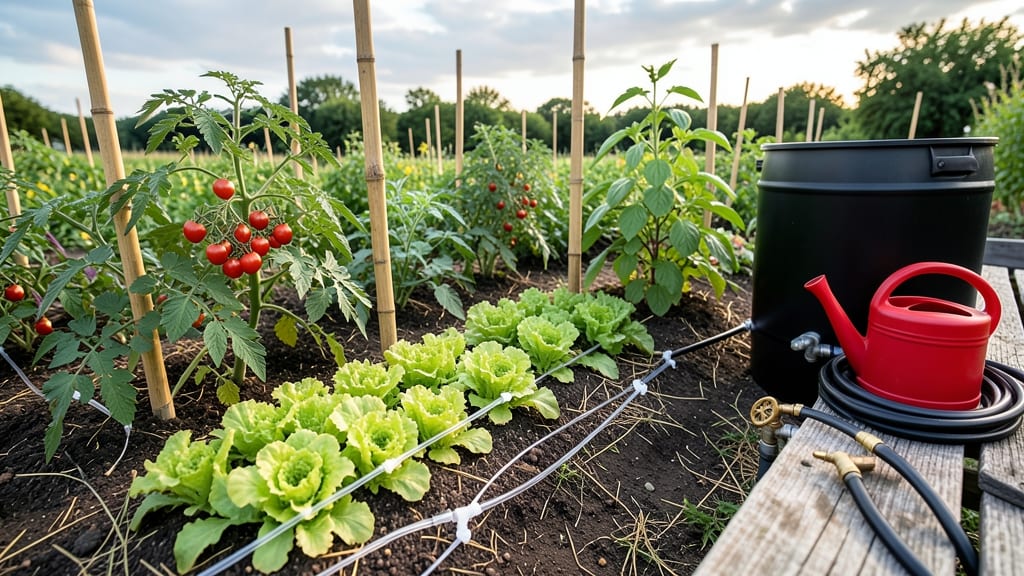
A DIY garden watering system lets you choose between drip irrigation or sprinklers, with drip setups typically costing $50–$200 and sprinkler systems ranging from $100–$300 based on materials, pipe length, and automation features like timers or solar-powered controllers.
A DIY garden watering system gives you full control over efficiency and cost, but your choice depends on your garden's size and needs. 💧 Drip irrigation saves water by delivering moisture directly to plant roots, making it ideal for vegetable gardens or flower beds where precision matters.
On the other hand, sprinkler systems cover larger areas quickly but can waste water through evaporation or overspray. Many gardeners start with basic setups and later upgrade to automated timers or solar-powered controllers to cut labor and improve consistency.
For beginners, the initial cost difference often comes down to tubing and hardware—drip systems use smaller, more affordable components, while sprinklers require sturdier pipes and heads.
I recommend testing a small section of your garden with both methods before committing to a full setup, as soil type and plant spacing can dramatically affect performance.
💡 In This Article
- Drip vs. Sprinkler Systems: Key Cost and Efficiency Differences
- Budget-Friendly DIY Garden Watering System Materials Guide
Drip vs. sprinkler systems: key cost and efficiency differences
Drip irrigation delivers water precisely where plants need it—directly to the soil surface near roots—using a network of small tubes and emitters.
The cost breakdown typically starts with $50 for a basic setup covering 100 square feet, including ¼-inch tubing ($0.10–$0.30 per foot), emitters ($0.50–$2 each), and a simple valve.
This method uses 30–50% less water than sprinklers because it minimizes evaporation and runoff, making it ideal for containers, raised beds, or drought-prone areas. The labor time for installation averages 1–2 hours for a small garden, but complex layouts with multiple zones can extend this to 4–6 hours. 💧
Sprinkler systems, on the other hand, rely on overhead watering through heads attached to larger pipes, which increases material costs. A basic setup for 500 square feet might run $150–$250, with ½-inch PVC pipes costing $1–$3 per foot and sprinkler heads ranging from $5–$20 each.
These systems cover larger areas quickly but waste 40–60% more water due to wind drift and evaporation, especially in open spaces. Installation time varies widely—simple setups take 2–3 hours, while automated systems with timers or solar controllers can require 5–8 hours to configure properly.
The trade-off? Sprinklers are easier to adjust for lawns or wide-row crops where drip systems would require excessive tubing.
Automation features like timers or solar-powered controllers add $30–$100 to either system but pay off in long-term savings. A drip system with a $50 timer can reduce water bills by 20–30% annually, while sprinklers with a $75 solar controller eliminate manual labor.
The key difference lies in precision: drip systems target specific plants, while sprinklers blanket entire zones. For example, a 20-foot row of tomatoes might need 10 emitters in a drip setup but only 1–2 sprinkler heads for full coverage.
This precision also reduces disease risk by keeping foliage dry—a critical factor for leafy greens or berries. 🌱
Consider your garden’s layout and plant types when choosing. Drip systems excel in small, high-value areas like herb gardens or strawberry patches, where water conservation and targeted feeding matter most. Sprinklers shine in large lawns or vegetable plots where uniform coverage is prioritized over efficiency.
For instance, a 1,000-square-foot vegetable garden might require $200 in drip tubing and emitters but only $150 in PVC and sprinkler heads for a sprinkler setup. However, the drip system would use half the water over a growing season, saving $50–$100 annually on utility bills.
This cost-efficiency becomes even more significant in regions with water restrictions or high utility rates.
Labor time also shifts based on automation. A manual drip system with 20 emitters might take 1 hour to set up, while adding a $40 timer adds 30 minutes of configuration. Sprinklers, however, demand more upfront effort—adjusting heads for even distribution can take 2–3 hours for a 500-square-foot area.
The payoff? Automated sprinklers can run unattended for weeks, while drip systems require occasional checks for clogs or leaks. For busy gardeners, this trade-off between hands-on maintenance and convenience often tips the scales toward sprinklers. 💡
Long-term savings hinge on water usage and plant health. A well-designed drip system can reduce water consumption by up to 60% compared to sprinklers, translating to $200–$400 in annual savings for large gardens. However, the initial investment in high-quality tubing and filters (adding $20–$50) ensures longevity.
Sprinklers, while cheaper upfront, may require $100–$200 in annual water costs for the same garden size. The choice ultimately depends on whether you prioritize precision and efficiency (drip) or convenience and broad coverage (sprinklers).
For mixed gardens, many DIYers opt for a hybrid approach—drip for beds and sprinklers for lawns—to balance both needs.