
Pests
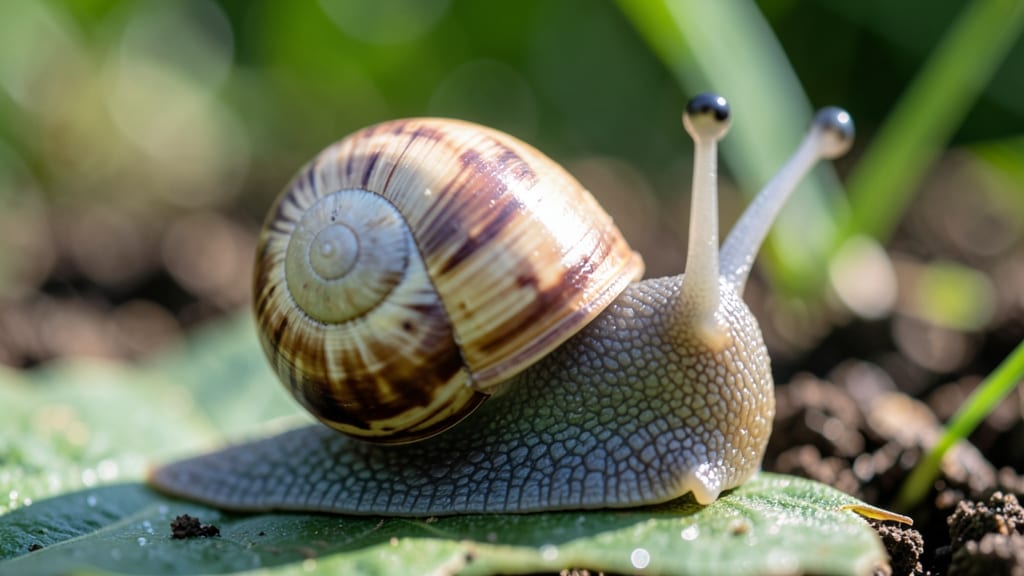
Understanding garden snail anatomy reveals how their coiled shell protects their soft body, their muscular foot allows movement, and their retractable head—complete with sensory tentacles, eyes, and a radula—helps them navigate, sense their environment, and scrape plant material for food.
Garden snails have evolved some truly fascinating features that make them masters of survival in damp environments. 🌱 Their coiled shells aren't just for show—they provide essential protection from predators and dehydration, while their large, muscular foot secretes mucus to help them glide silently across surfaces.
The two pairs of sensory tentacles (longer for smelling and shorter for vision) act like a built-in early warning system, allowing them to detect threats from up to a foot away.
What's especially interesting is their radula—a tiny, rasp-like tongue covered in thousands of teeth—that lets them scrape even the toughest plant surfaces to access nutrients.
These anatomical adaptations explain why garden snails thrive in moist conditions and why they're such effective garden pests. The mucus trail they leave behind isn't just for movement—it helps maintain moisture around their bodies, while their plant-scraping habits can quickly turn a healthy garden into a buffet.
Understanding these features helps gardeners implement more effective control strategies that target the snails' vulnerabilities rather than just their visible damage.
💡 In This Article
- How Garden Snail Body Parts Aid Survival
- Identifying Key Snail Anatomy for Gardeners
How garden snail body parts aid survival
The coiled shell is the snail's primary defense mechanism, acting like a portable fortress. Made of calcium carbonate, this spiral structure grows with the snail over time, with each new whorl adding protection. The shell's shape isn't random—it maximizes surface area for muscle attachment while minimizing weight.
When threatened, the snail retracts completely inside, sealing the opening with a thick mucus barrier that deters predators like birds and beetles. 🔥 This shell also plays a crucial role in moisture retention, as its porous surface absorbs water vapor from humid air, helping the snail survive dry periods.
The muscular foot isn't just for movement—it's a multi-purpose powerhouse. Covered in tiny cilia (hair-like structures), it secretes a trail of mucus that serves three critical functions: lubrication for silent gliding, a protective barrier against abrasion, and a moisture-retaining layer that prevents dehydration.
This foot can exert enough pressure to lift objects 50 times the snail's body weight, allowing it to scale vertical surfaces and navigate obstacles. The foot's texture changes depending on conditions—rougher when climbing and smoother when gliding, demonstrating remarkable adaptability.
The retractable head houses the snail's most sophisticated sensory equipment.
Those two pairs of tentacles might look delicate, but they're packed with specialized organs: the longer pair detects chemical cues (like rotting leaves or predator scents) through 1,000+ sensory receptors, while the shorter pair contains eyes at the tips that can detect movement up to 12 inches away.
This dual sensory system creates a 360-degree awareness that's crucial for avoiding threats. The eyes are particularly fascinating—they're mounted on stalks that can retract instantly when danger approaches, protecting them from damage.
Perhaps most specialized is the radula, a ribbon-like structure in the mouth covered with 10,000-20,000 microscopic teeth. This rasp-like tongue can wear down plant surfaces with incredible precision, allowing the snail to access nutrients from leaves, stems, and even bark.
The radula's teeth are constantly being replaced—like a conveyor belt of tiny chisels—with new teeth forming at the base and old ones being shed at the front. This adaptation explains why garden snails can devour entire seedlings overnight, leaving behind telltale slime trails and irregular feeding marks.
What ties all these features together is their perfect adaptation to moist environments. The mucus trail maintains hydration, the shell prevents water loss, and the sensory equipment helps locate water sources. Even their diet—decaying plant matter—provides both nutrition and moisture.
This integrated system makes garden snails incredibly resilient pests, capable of thriving in conditions that would challenge many other creatures. 💫 Understanding these adaptations helps explain why traditional control methods often fail—the snails' very anatomy makes them hard to eliminate without targeting multiple vulnerabilities simultaneously.