
How To
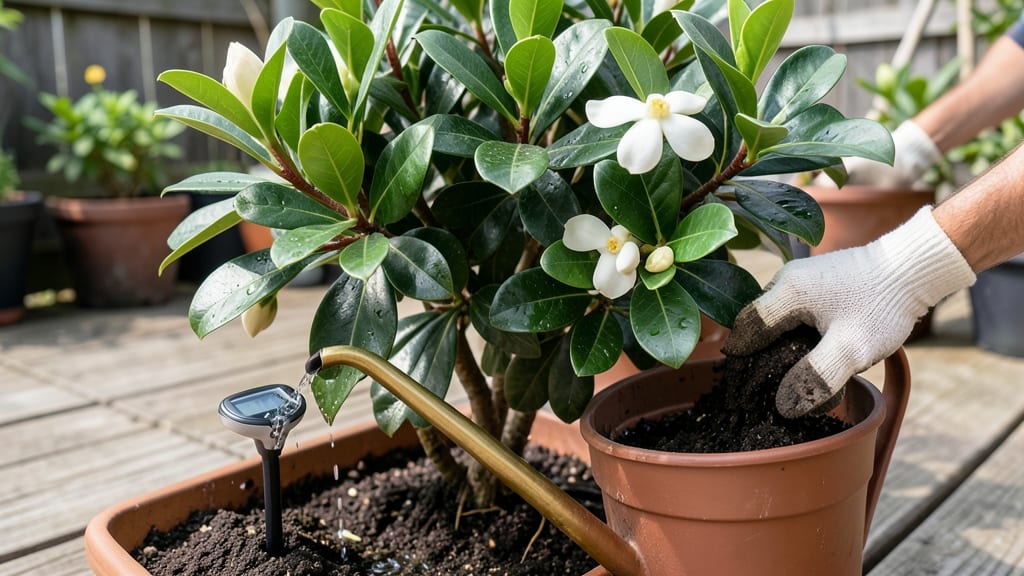
To water gardenias properly, check soil moisture every 2-3 days in summer and adjust for seasons — too much or too little spells disaster for those fragrant blooms.
Struggling to keep your gardenia 🌸 blooming beautifully? The secret isn’t just how much you water—it’s when and how you check the soil first. Get the timing wrong, and you’ll either drown the roots or watch your plant wilt from thirst.
Gardenias thrive in moist but never soggy soil, which means skipping the guesswork and testing moisture at root depth. A simple finger test or lifting the pot reveals whether it’s time to water again — no more over- or under-doing it.
Below, I’ll break down the exact schedule for spring blooms, how to adjust for pots vs. in-ground plants, and the early signs your watering habits are killing your gardenia before it even starts.
Gardenias watering schedule: the 3-Zone soil test method
Your gardenia’s health and blooms depend on consistent moisture, but guessing won’t cut it. Overwatering suffocates roots, while underwatering causes bud drop. The 3-Zone Soil Test Method lets you water with precision by checking soil moisture at root depth—not just the surface.
This science-backed approach adjusts for your climate, pot size, and seasonal shifts.
Start by identifying your gardenia’s three moisture zones: the top 1 inch (surface), 2-3 inches (root zone), and 4+ inches (deep roots). The 2-3 inch zone is your golden indicator—this is where roots actively absorb water.
Test it daily during heatwaves or every 2-3 days in cooler weather. Here’s how to do it right.
| Zone | Depth | Test Method | Ideal Moisture | Water When |
|---|---|---|---|---|
| Surface | 0-1" | Finger dip | Slightly dry | Top up if dry |
| Root Zone | 2-3" | Finger test | Moist but not soggy | Water deeply if dry |
| Deep Roots | 4+" | Weight method | Consistently damp | Adjust schedule if dry |
The finger test is your go-to tool. Stick your index finger 2-3 inches deep into the soil. If it feels dry or crumbly, it’s time to water. Aim for soil that’s moist like a wrung-out sponge—not bone-dry or muddy.
For potted gardenias, lift the pot: a dry pot means roots are thirsty, while a heavy pot signals overwatering.
Climate plays a huge role. In humid summers (like Zone 8-9), gardenias may need daily watering if the 2-3 inch zone dries quickly. In drier zones (Zone 6-7), stretch watering to every 3-4 days.
Always water in the morning to let foliage dry before nightfall, reducing fungal risks like powdery mildew.
Seasonal shifts demand adjustments. During blooming season (spring-summer), gardenias drink more—monitor the deep roots zone closely. In fall and winter, reduce watering to every 5-7 days as growth slows. Yellowing leaves or dropping buds? Your watering schedule is likely off—check the 3 zones immediately.
Pot size matters too. A 5-gallon container dries out faster than in-ground soil, so water potted gardenias every 1-2 days in summer. For ground-planted shrubs, the soil retains moisture longer—stick to every 3-5 days.
Always water until it drains from the bottom of pots to prevent root rot.
Watch for visual cues beyond the soil test. Wilted leaves that don’t perk up after watering signal root stress. Brown leaf edges often mean underwatering, while yellow leaves with mushy stems warn of overwatering. Adjust your schedule based on these signs, not just a calendar.
Mulch is your secret weapon. Apply 2-3 inches of organic mulch (like pine bark) around your gardenia to lock in moisture and regulate soil temperature. This reduces evaporation by up to 30%, cutting your watering frequency by 1-2 days per week.
Just keep mulch 2 inches away from the stem to avoid rot.
Finally, track your gardenia’s habits. Keep a watering journal for 4 weeks, noting when you water, how much, and the 3-zone moisture levels. You’ll spot patterns—like heatwaves or rainy spells—that help you fine-tune your schedule. Over time, you’ll water like a pro, with fewer wil
Common watering mistakes that kill gardenias (and how to fix them)
Gardenias are finicky about water—too much or too little can send your plant into a downward spiral. I’ve seen yellowing leaves from overwatering and drooping buds from thirst, and both are heartbreaking for any gardener.
The key is consistency, but even that can backfire if you’re not paying attention to the right details.
Most gardeners assume a simple watering schedule works, but gardenias need specific conditions to thrive. For example, potted gardenias dry out faster than in-ground plants, and summer heat changes the game entirely.
Let’s tackle the top 5 watering mistakes and how to fix them before your gardenia throws in the towel.
⚠️ How Often to Water Gardenia?
Check soil moisture every 2-3 days by sticking your finger 2 inches deep. If it feels dry, water deeply until it drains from the bottom. Morning watering is best—never water at night (fungal risk!). Adjust for pots (daily in summer) vs. ground (every 3-5 days).
Mistake #1: Overwatering is the silent killer. Gardenias hate soggy roots, which lead to root rot and yellow leaves. I’ve seen gardeners drown their plants by watering on a strict daily schedule, ignoring the soil’s actual moisture level.
The fix? Wait until the top 2 inches of soil are dry before watering again. Use a well-draining soil mix with perlite or sand to prevent compaction.
Mistake #2: Underwatering causes buds to drop before blooming, and the leaves will curl and crisp at the edges. Many gardeners think "less is more," but gardenias need consistent moisture.
If your plant looks thirsty, give it a deep soak—aim for 1-2 gallons per plant—and mulch around the base to retain humidity. In extreme heat, you may need to water daily.
Mistake #3: Inconsistent watering schedules confuse gardenias. They thrive on predictability, so switching between daily watering and weekly soaks stresses the plant. Stick to a routine (e.g., every 2-3 days in summer) and adjust only for weather changes.
Use a moisture meter to track soil conditions if you’re unsure.
Mistake #4: Using the wrong soil mix traps moisture, leading to root suffocation. Gardenias need acidic, well-draining soil (pH 5.0-6.5). If your soil is heavy clay or lacks organic matter, amend it with peat moss or compost.
For potted gardenias, mix in orchid bark or perlite to improve aeration.
Mistake #5: Ignoring drainage is a recipe for disaster. Gardenias cannot tolerate standing water, so ensure pots have drainage holes and in-ground plants are planted on a slight slope.
If water pools after rain, add gravel or sand to the planting hole to improve drainage. Always water until it flows freely from the bottom of the pot.