
Tools
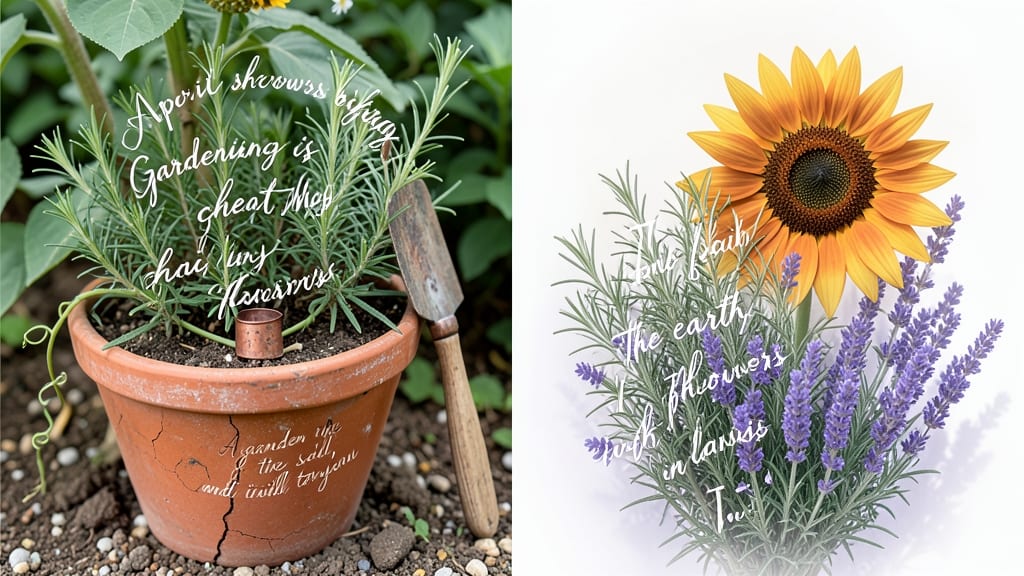
Quotes on gardening capture the essence of patience and growth, weaving together scientific insight from visionaries like Luther Burbank—who framed gardening as 'the art of making nature work for you'—with poetic beauty from voices like Emily Dickinson’s 'Hope is the thing with feathers.' These words remind us that gardening is both a practical craft and a spiritual practice.
Gardening quotes serve as more than just decorative phrases—they reflect the core principles of horticulture. 🌱 Many of the most beloved quotes come from botanists and poets who understood that plants mirror human growth: they require time, care, and resilience.
For example, Thomas Jefferson's garden journals reveal his belief that 'the greatest service which can be rendered any country is to add a useful plant to its culture,' showing how gardening connects us to both nature and history.
These words don't just inspire; they create a framework for how we approach our green spaces, whether we're tending to heirloom tomatoes or simply watching a seedling push through soil.
What makes these quotes particularly powerful is their ability to transform mundane tasks into meaningful rituals. 💫 When you pair a quote like 'April showers bring May flowers' with your spring planting, you're not just watering seeds—you're participating in a centuries-old cycle of renewal.
The best gardeners use these words as anchors, turning moments of frustration (like wilting leaves) into opportunities for reflection and learning.
Whether you're framing a quote in your greenhouse or jotting one in your garden journal, you're creating a personal connection to the land—and to the wisdom of those who came before you.
💡 In This Article
- Historical Gardening Quotes That Shape Modern Horticulture
- How to Use Gardening Quotes for Motivation and Garden Journaling
Historical gardening quotes that shape modern horticulture
Thomas Jefferson’s garden journals reveal why his quote—'The greatest service which can be rendered any country is to add a useful plant to its culture'—still resonates today. Jefferson’s Monticello gardens weren’t just decorative; they were scientific experiments.
He meticulously recorded 175 plant varieties, including 33 types of grapes and 164 vegetables, proving how gardening bridges practicality and innovation. This mindset directly influenced modern seed-saving movements, where gardeners preserve heirloom varieties to maintain biodiversity.
George Washington Carver’s work with peanuts and sweet potatoes transformed agricultural practices. His famous line—'Where there is no vision, there is no hope'—reflects his belief that farming should be both sustainable and visionary.
Carver’s experiments with 300+ uses for peanuts, from milk to dye, demonstrated how plants could solve economic and environmental challenges. Today, his principles underpin regenerative farming, where crops like cover plants restore soil health.
Anne Frank’s poignant words—'Look at how a single candle can both defy darkness and be contained by it'—highlight gardening’s dual role: resilience amid struggle. Her hidden garden symbolized hope during World War II, mirroring how modern urban gardeners use containers on balconies to grow food in limited spaces.
This quote reminds us that even small green spaces can foster connection and survival, much like victory gardens did during wartime.
Luther Burbank’s quote—'The art of making nature work for you'—explains his methodical approach to plant breeding. He cross-pollinated 200+ plant species to create disease-resistant varieties, like the Shasta daisy, which thrives in 90% of U.S. climates.
His work laid the foundation for genetic research, proving that human intervention can enhance nature’s resilience. This science-backed optimism fuels today’s climate-adaptive gardening.
These quotes aren’t just historical footnotes—they’re blueprints for action. Jefferson’s plant trials inspired botanical gardens like Kew, Carver’s innovations led to USDA crop research, and Frank’s garden became a symbol of therapeutic horticulture. Their words turn gardening from a hobby into a movement for change.
Consider how these figures’ legacies overlap: Jefferson’s precision, Carver’s sustainability, and Frank’s hope. Together, they show that gardening is both an ancient practice and a modern necessity, blending history with the future. 🌱