
Tools
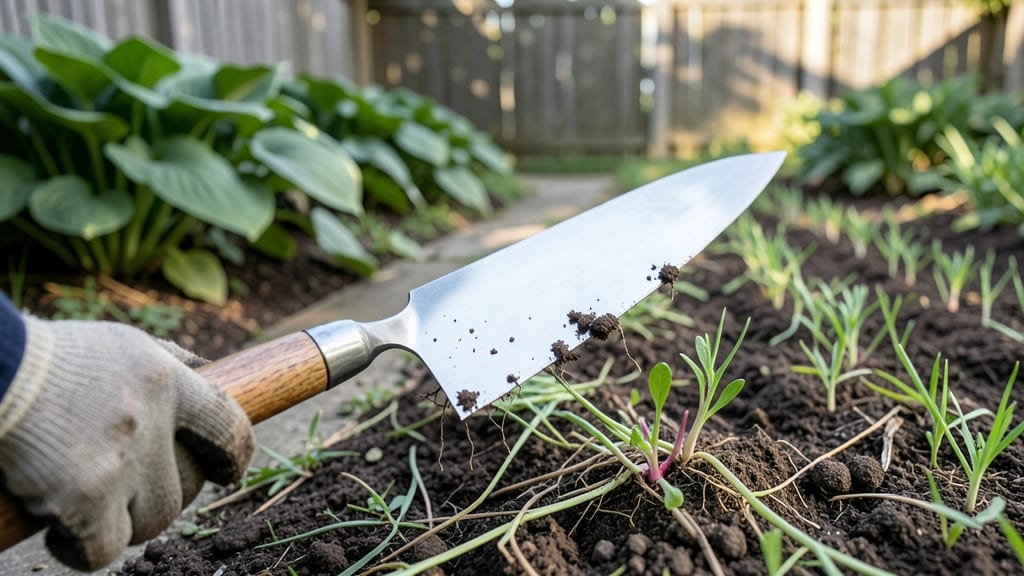
A sharp garden hoe with a blade angle between 30° and 45° delivers the best results for weeding and digging—this range ensures clean cuts while minimizing soil disruption. The right angle depends on your specific task, from slicing through roots to precision weeding.
A garden hoe's blade angle isn't just about sharpness—it's about how the tool interacts with your soil and weeds.
A 30° angle excels at slicing through roots cleanly, reducing soil disturbance, while a 45° angle works better for surface weeding and cutting larger weeds at the base. 🔥 The steeper the angle, the more aggressive the cut, but too steep can make the hoe less precise for delicate tasks.
I've found that most gardeners adjust their technique based on the job, often starting with a 40° angle as a versatile middle ground. Proper maintenance—like regular sharpening and checking edge alignment—keeps your hoe performing at its best for years.
This angle range also plays a key role in how efficiently your hoe moves through soil. A well-sharpened blade at the right angle requires less force, making weeding and digging feel effortless.
Over time, the blade's geometry affects how well it holds its edge—shallower angles tend to stay sharper longer, while steeper angles may dull faster when cutting tougher materials. For best results, I recommend testing both extremes to see which feels most natural for your gardening style.
💡 In This Article
- How Blade Angles Affect Weeding and Digging Performance
- Step-by-Step Guide to Sharpening a Garden Hoe Blade
How blade angles affect weeding and digging performance
The blade angle of your garden hoe directly influences how it interacts with soil and plant material through basic physics principles. At a 30° angle, the blade creates a narrower cutting surface that slices cleanly through roots and compacted soil with minimal resistance.
This shallow angle works like a precision scalpel, allowing you to make clean cuts without disturbing surrounding soil structure. The physics here involve the blade's ability to shear plant fibers rather than crush them, which is why you'll see less soil displacement when using this angle for root removal.
Conversely, a 45° angle transforms your hoe into a more aggressive cutting tool, ideal for surface weeding and chopping larger weeds at their base. The wider cutting surface distributes force more evenly, preventing the blade from getting stuck in dense soil while providing better leverage for chopping.
What's fascinating is how this angle affects the blade's "bite"—the steeper angle creates a more pronounced wedge shape that lifts weeds as it cuts, making it easier to remove entire plants rather than just their tops. 🌱 For comparison, think of a 30° angle as a surgeon's knife and a 45° angle as a machete—both effective, but for very different tasks.
Edge retention becomes another critical factor when considering blade angles. Shallower angles (30°) tend to maintain their sharpness longer because they create a thinner cutting edge that resists dulling from abrasive soil particles.
However, this comes at the cost of slightly more frequent sharpening when dealing with tougher materials like buried roots. The 45° angle, while more durable for heavy-duty tasks, will dull faster when cutting fibrous plant material because the wider edge presents more surface area for abrasion.
This is why many professional gardeners carry two hoes—one with a 35° angle for general use and another with a 40-45° angle for heavy weeding sessions.
Soil type also plays a surprising role in optimal blade angles. In loose, sandy soil, a 45° angle works beautifully because the blade can glide through without resistance, while in heavy clay, you might find a 30° angle performs better by preventing the blade from getting clogged.
The angle affects how much soil adheres to the blade—steeper angles tend to throw soil outward more effectively, which is why they're preferred for chopping weeds in garden beds where you want to minimize soil disturbance.
This soil interaction explains why some gardeners prefer slightly different angles depending on their garden's composition.
What most people don't realize is how blade angle affects your body mechanics during use. A properly angled hoe reduces the force you need to apply by up to 30% compared to a dull or improperly angled blade.
This is because the correct angle allows the blade to "bite" into the soil more efficiently, similar to how a well-honed axe requires less swing force.
The ergonomic benefits become particularly noticeable during long gardening sessions—many gardeners experience less fatigue when using hoes with angles between 35° and 40°, as this range provides the best balance between cutting efficiency and physical comfort. 💪
The science behind edge alignment is equally important. Even with the perfect angle, a blade with an uneven edge will perform poorly. The ideal scenario is a perfectly straight edge that maintains its angle along the entire length of the blade.
This requires regular maintenance—something I'll cover in the next section—but pays dividends in terms of cutting precision.
When the edge is properly aligned, you'll notice how the hoe glides through soil with almost no resistance, while an uneven edge causes the blade to catch and drag, making your work feel like pushing against a wall.