
Tools
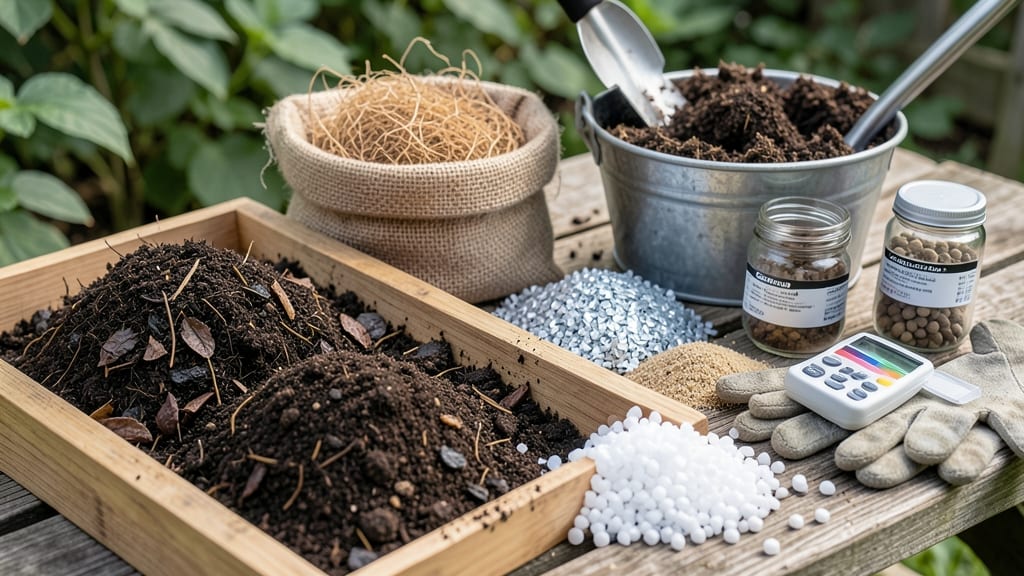
For garden soil improvement, use compost to add nutrient-rich organic matter, aged manure for balanced fertility, and peat moss or coconut coir to enhance moisture retention and aeration. Tailor the mix to your specific soil type and plant requirements.
Building healthy garden soil isn't just about throwing in random materials—it's about creating a thriving ecosystem. Compost acts like a natural fertilizer, feeding beneficial microbes that break down organic matter into plant-available nutrients.
Aged manure, on the other hand, provides a slow-release nutrient boost that won't burn roots, while peat moss or coconut coir helps sandy soils hold moisture longer. 🌱 The key is testing your soil first to identify deficiencies—whether it's too compacted, too acidic, or lacking organic material.
For example, clay-heavy soils benefit from generous compost layers, while sandy soils need more moisture-retentive amendments.
Timing matters just as much as the materials. Spring is ideal for mixing amendments into garden beds before planting, while fall applications give them time to integrate naturally. For container gardens, I blend equal parts compost and coconut coir with a handful of worm castings for extra microbial activity.
The goal? Soil that's crumbly, dark, and teeming with life—because happy soil equals happy plants.
💡 In This Article
- How Organic Amendments Boost Soil Health
- When and How to Mix Soil Amendments for Different Plants
How organic amendments boost soil health
Compost acts like nature's multivitamin for soil—it activates beneficial microbes that break down organic matter into plant-available nutrients. These microbes create tiny pores between soil particles, improving aeration while holding moisture.
Think of it as a sponge with built-in drainage: compost can hold up to 20% more water than unamended soil while still allowing oxygen to reach roots. The decomposition process also generates heat (140-160°F in active piles), which sterilizes pathogens and speeds up nutrient cycling.
Aged manure works differently by providing a slow-release nutrient cocktail. Cow or horse manure, when properly composted for 6-12 months, contains balanced nitrogen, phosphorus, and potassium (NPK ratio ~1-0-0 to 2-1-1). The key difference from fresh manure is the absence of ammonia spikes that can burn young plants.
For example, a 2-inch layer of composted cow manure spread over garden beds can supply nutrients for an entire growing season while improving soil structure. The organic matter also helps sandy soils cling to nutrients longer, reducing leaching.
Peat moss and coconut coir serve as moisture regulators by increasing soil's water-holding capacity without suffocating roots. Peat moss, with its 16-20% organic matter content, can absorb up to 20 times its weight in water while maintaining aeration.
Coconut coir offers a sustainable alternative with similar moisture retention but better drainage. Both amendments create a fluffy, crumbly texture that mimics ideal loam soil. For container gardens, mixing 30% coir with 70% compost creates a lightweight medium that prevents compaction while keeping roots hydrated.
The real magic happens when these amendments work together. For instance, combining compost (for microbes), aged chicken manure (for phosphorus boost), and peat moss creates a power trio: microbes break down nutrients, phosphorus supports root growth, and peat moss prevents moisture loss.
This synergy explains why vegetable gardens amended with all three often produce 30-50% higher yields than unamended plots. The soil becomes a living ecosystem where roots can easily penetrate and access nutrients.
Don't overlook the pH balancing act. Compost typically raises soil pH slightly (from 6.0 to 7.0), while aged manure can lower it (especially poultry manure). Peat moss is naturally acidic (pH 3.5-4.5), which makes it ideal for acid-loving plants like blueberries or azaleas.
Testing your soil's pH before mixing amendments helps you create the perfect environment for your plants. For example, adding 1 part lime to 10 parts compost can neutralize acidic soils without overcorrecting.
One often-missed benefit is how these amendments improve soil's cation exchange capacity (CEC). CEC measures a soil's ability to hold onto essential nutrients like calcium, magnesium, and potassium. Compost can increase CEC by 20-30%, allowing plants to access nutrients more efficiently.
This is particularly crucial for heavy feeders like tomatoes or corn, which deplete soil nutrients rapidly. The result? Plants with stronger stems, higher yields, and better disease resistance.
For visual learners, imagine healthy soil as a dark chocolate cake with crumbly texture—rich, moist, and full of air pockets. That's what you're creating when you combine these amendments properly.
The key is patience: give amendments 4-6 weeks to integrate before planting, especially in clay soils where compaction is an issue. 🌱