
Size
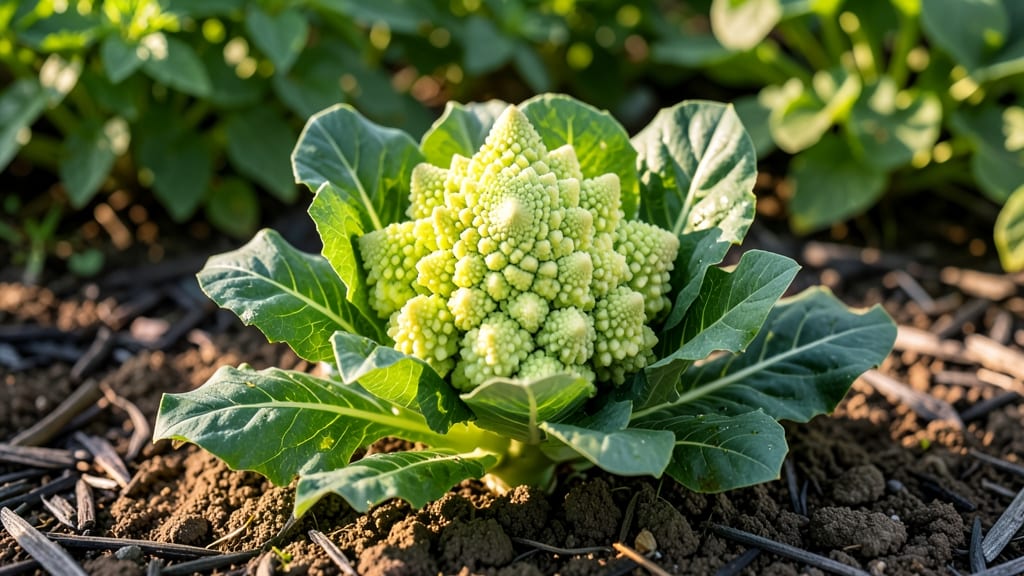
Yes, romanesco grows back in a garden after harvest as a biennial plant—pruning the main head triggers lateral shoots, though productivity declines without replanting seeds. Hardy varieties can overwinter in mild climates.
This fractal-shaped brassica behaves like a perennial in its first year, storing energy to regenerate. 🌱 When you harvest the central head, the plant redirects growth to side shoots, much like artichokes.
However, each regrowth cycle produces smaller yields, so many gardeners treat it as an annual after the first harvest. Cold tolerance varies by variety—some survive down to 20°F with proper mulching, while others need winter protection in colder zones.
For best results, harvest when the main head reaches 8-10 inches in diameter, leaving at least 2 inches of stem attached. This preserves the plant's energy reserves for regrowth. After harvest, water deeply and apply compost to replenish nutrients—think of it as giving your plant a post-surgery recovery boost. 💫
💡 In This Article
- Why Romanesco Regrows After Harvesting
- Maximizing Romanesco Regrowth in Your Garden
Why romanesco regrows after harvesting
Romanesco's ability to regrow stems from its unique biennial life cycle combined with a clever biological trick called apical dominance. This phenomenon occurs when the main central bud (the apical meristem) produces hormones that suppress the growth of side buds.
When you harvest the main head, you're essentially removing this growth inhibitor, allowing the plant to redirect its energy toward dormant lateral shoots. 🌿 The plant's stored energy in its thick stem and roots acts like a battery, fueling this regrowth process—similar to how a tree sends out new branches after a pruning cut.
Temperature plays a critical role in this process. Romanesco thrives in cool weather, with optimal regrowth occurring between 55-75°F. Below 45°F, growth slows dramatically, while temperatures above 80°F can stress the plant.
The plant's cold-hardiness varies by variety—some can tolerate brief exposures to 20°F, while others need protection above 30°F. Soil health is equally important: well-draining soil rich in organic matter (like compost) provides the nutrients needed for regrowth, while poor soil leads to weak, stunted shoots.
Here's what happens at the cellular level: When you remove the main head, the plant's vascular system—its internal plumbing—redirects water and nutrients to the lateral buds. These buds contain meristematic cells that begin rapid division within 7-14 days of harvesting, visible as small bumps along the stem.
The plant's fractal growth pattern means these new shoots will develop the same geometric structure as the original head, though typically on a smaller scale. 💫 This regrowth isn't infinite, however—the plant's energy reserves deplete with each cycle, which is why yields diminish over successive harvests.
The regrowth process also depends on light exposure. Romanesco needs 6-8 hours of direct sunlight daily to maintain strong growth. Inadequate light leads to leggy, weak shoots that produce smaller heads. You'll notice the new growth starts with tight, green buds that gradually unfurl into the characteristic lime-green, fractal-shaped florets.
The timing of regrowth varies—some gardeners see new shoots in 3-4 weeks, while others wait 6-8 weeks, depending on growing conditions.
An interesting comparison is with its cousin, broccoli. While both are brassicas, romanesco's regrowth is generally more vigorous because its thicker stems store more energy. However, unlike broccoli which can produce multiple harvests from a single planting, romanesco's regrowth becomes less productive after the second harvest.
This is why many gardeners opt to replant seeds for a fresh crop rather than relying on regrowth after multiple cycles. 🌱
What most gardeners don't realize is that the plant's age affects regrowth quality. First-year plants (those grown from seed) typically produce the most robust regrowth, while older plants may struggle to recover. This is because younger plants have more vigorous root systems and stored energy.
The key to maximizing regrowth lies in balancing harvest timing—removing the main head when it's fully mature (8-10 inches) but before it starts to yellow, which indicates the plant is redirecting energy to seed production.