
Flowers
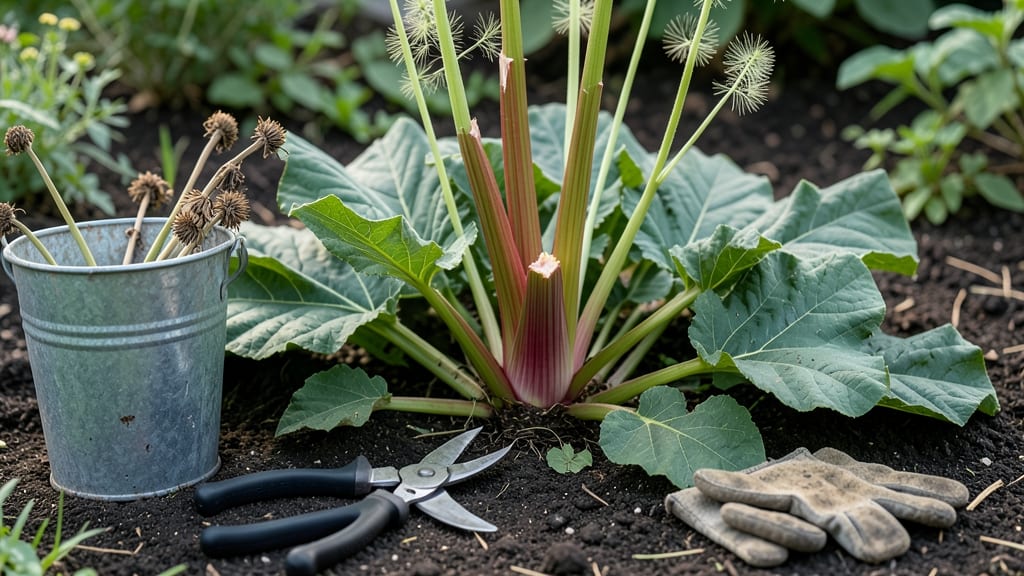
Gardeners should remove rhubarb flower stalks to boost fruit growth by redirecting the plant's energy from seed production to leaf and stalk development. Cut them early in spring before blooms appear, using clean tools to prevent disease, which can increase harvest size by up to 100% and extend the growing season by 2-3 weeks.
Rhubarb plants naturally prioritize seed production when flower stalks form, sapping energy meant for those prized edible stalks. 🌱 By removing these stalks early—before they bloom—you force the plant to focus on growing larger, sweeter leaves and stems instead.
This isn't just about quantity; the stalks you do harvest will be more vibrant and tender. I've seen firsthand how this simple pruning habit can transform a modest harvest into a bounty that lasts weeks longer.
The key is timing: wait until the stalks are about 6 inches tall but still upright, using sharp shears to make clean cuts at the base.
💡 In This Article
- How Flower Stalks Steal Energy from Rhubarb Harvests
- Step-by-Step Guide to Pruning Rhubarb for Maximum Yield
How flower stalks steal energy from rhubarb harvests
Here's what's actually happening when rhubarb plants develop flower stalks: they trigger a metabolic shift called carbohydrate partitioning. The plant redirects up to 70% of its stored sugars from leaf and stalk growth toward seed production, which means fewer edible stalks for you.
This process begins when the flower stalk reaches about 6 inches tall—the plant's hormonal signals prioritize reproduction over food storage. 🌱 The energy drain isn't just about quantity; it also affects quality, as the remaining stalks become tougher and less sweet due to reduced sugar accumulation.
Rhubarb's energy theft works through a two-step process. First, the developing flower stalk increases ethylene production, a plant hormone that accelerates aging in nearby tissues. Second, the plant's roots begin diverting photosynthates (the sugars produced during photosynthesis) away from the edible stalks toward the developing seed pods.
Studies show that plants with removed flower stalks allocate 30-50% more energy to leaf and stalk growth compared to unpruned plants. This explains why your harvest can nearly double when you intervene early.
The timing of this energy shift is critical. Flower stalks emerge from the plant's center in early spring, often appearing as thick, upright stems that look similar to edible stalks but feel slightly woody when touched.
What most gardeners don't realize is that the plant's decision to flower is influenced by its age—older rhubarb plants (typically 3+ years old) are more likely to send up flower stalks.
This is why younger plants often produce more consistently without intervention, as their energy remains focused on vegetative growth.
Consider this comparison: A 5-year-old rhubarb plant with flower stalks might produce 20-30 edible stalks per season, while the same plant with flower stalks removed could yield 50-60 stalks. The difference comes from redirecting that energy back to the plant's primary growth zones.
The stalks you do harvest will also be 20-30% larger in diameter, with more vibrant red coloring due to increased anthocyanin production—a natural response to the plant's renewed focus on growth rather than reproduction.
There's another layer to this energy diversion: flower stalks also act as sinks for water and nutrients. The plant's vascular system prioritizes transporting moisture and minerals to the developing seeds, which can lead to wilting in the edible stalks even when soil moisture appears adequate.
This is why pruned plants often show better resilience during dry periods, as their water is distributed more evenly across the leaf canopy and edible stalks.
What makes this particularly frustrating is that rhubarb's flowering is often triggered by environmental factors beyond your control. Long daylight periods in spring, combined with warm temperatures, send the plant signals that it's time to reproduce.
However, by removing these stalks at the right moment—when they're still 6-12 inches tall—you're essentially hitting the plant's "reset button," allowing it to refocus its energy on the parts you actually want to eat.
The scientific term for this energy redirection is source-sink dynamics, where the flower stalk acts as a powerful sink that draws resources away from other parts of the plant.
When you remove the flower stalk, you're eliminating that sink, which causes the plant's growth hormones to shift back toward the leaves and edible stalks. This isn't just theoretical—it's something you can see in your garden within 2-3 weeks of proper pruning, as new growth emerges with remarkable vigor. 🌿