
Tools
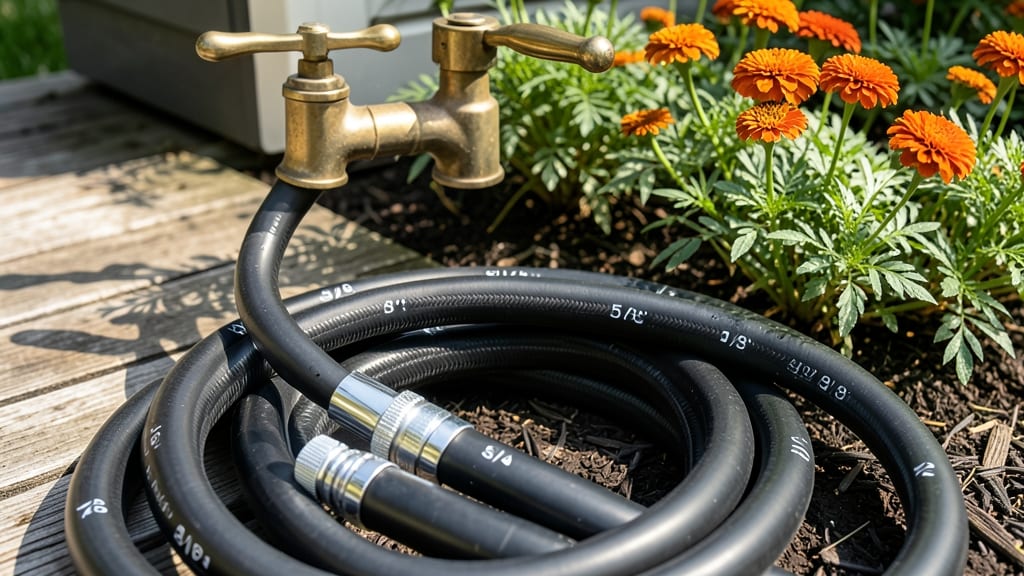
Selecting the correct inside diameter for your garden hose directly impacts water pressure and flow rate, with 5/8-inch being the standard for most household gardens and 3/4-inch or 1-inch recommended for high-volume tasks like sprinkler systems or large lawns. Larger diameters minimize pressure loss over extended lengths but may require reinforced fittings.
The inside diameter of your garden hose determines how efficiently water travels through it—thinner hoses create more resistance, while wider ones maintain pressure even over long distances. 💦 For example, a 5/8-inch hose works perfectly for watering flower beds or vegetable gardens, but if you're running a sprinkler system across a 50-foot yard, you'll likely need a 3/4-inch or 1-inch hose to keep the flow strong.
I’ve found that upgrading to a larger diameter can save time and frustration, especially when dealing with stubborn clogs or weak spray patterns.
Another key factor is the type of connectors you use—larger hoses often need heavy-duty brass or stainless steel fittings to handle the increased water pressure.
If you're unsure which size to choose, start with a 5/8-inch hose for general use and upgrade only when you notice pressure dropping during watering tasks.
💡 In This Article
- How Inside Diameter Affects Water Flow and Pressure
- Best Garden Hose Sizes for Different Watering Needs
How inside diameter affects water flow and pressure
The inside diameter of a garden hose directly influences water flow through a principle called laminar flow, where water moves more efficiently through wider passages.
A 5/8-inch hose has an internal diameter of about 0.625 inches, creating less friction than a 3/8-inch hose but more than a 3/4-inch (0.75-inch) or 1-inch (1.0-inch) hose.
This difference becomes critical over distance—water pressure drops about 10 psi per 100 feet in a 5/8-inch hose, but only 5 psi per 100 feet in a 3/4-inch hose due to reduced friction. 💦
Pressure loss occurs because of friction between water and the hose walls, which increases as the hose lengthens or the diameter shrinks.
For example, a 50-foot 5/8-inch hose might deliver water at 40 psi from a 60 psi source, while the same length in 3/4-inch could maintain 50 psi.
This matters for sprinklers, where 30 psi is ideal for even coverage—too little pressure means weak streams, and too much can damage delicate plants. Larger diameters also reduce the risk of cavitation, where rapid pressure drops create air bubbles that can damage pumps or sprinkler heads.
Real-world testing shows that a 1-inch hose delivers 2-3 times the flow rate of a 5/8-inch hose at the same pressure, making it ideal for large lawns or filling ponds. However, the trade-off is weight—1-inch hoses are heavier and require heavy-duty connectors to prevent leaks.
For most homeowners, a 5/8-inch hose strikes the best balance, while 3/4-inch is the sweet spot for high-efficiency sprinkler systems covering 1,500+ square feet. 🔧
Another factor is the Reynolds number, a ratio of inertial to viscous forces in fluid flow. Higher Reynolds numbers (found in larger hoses) indicate turbulent flow, which can actually improve mixing in sprinkler systems but may cause more noise.
In contrast, smaller hoses create laminar flow, which is quieter but less efficient over long distances. This is why professional irrigation systems often use 3/4-inch or larger hoses for main lines, even if individual zones use smaller diameters.
For drip irrigation, where precision matters most, a 5/8-inch hose with 1/4-inch emitters works perfectly—pressure drops are minimal over short runs, and emitters regulate flow to 0.5-2 gallons per hour. But for soaker hoses, which rely on low-pressure, high-volume seepage, a 3/4-inch hose ensures even moisture distribution without clogging.
The key is matching the hose diameter to both the water source pressure and the application method. 💧