
Watering
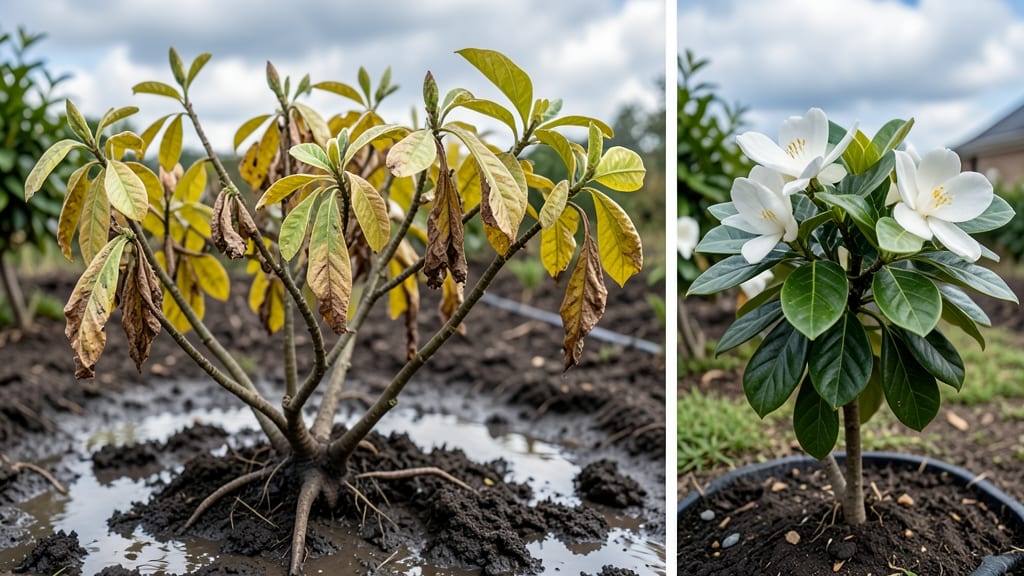
Yellow leaves on an overwatered gardenia show your plant is drowning in excess moisture. Rescue it by draining saturated soil, repotting in well-draining mix, and watering only every 10-14 days while keeping the root zone dry.
When gardenias turn yellow from too much water, the roots suffocate and can't absorb nutrients anymore.
This creates a perfect storm: root rot blocks oxygen, chlorophyll production stops, and leaves lose their vibrant green color. 🌿 The good news is that gardenias are resilient—once you correct the watering habits and improve drainage, new growth will emerge within 4-6 weeks, often with deeper green leaves than before.
Start by checking the soil moisture with your finger—if it's damp more than an inch below the surface, your plant needs immediate attention. Repot into a container with sand or perlite mixed into the soil to prevent compaction, and always use pots with drainage holes.
After repotting, let the top 2-3 inches of soil dry completely before watering again, and consider moving your gardenia to a location with morning sun and afternoon shade to reduce stress.
💡 In This Article
- How Overwatering Damages Gardenia Roots and Leaves
- Step-by-Step Recovery Plan for Overwatered Gardenias
How overwatering damages gardenia roots and leaves
When gardenias receive too much water, the roots first experience oxygen deprivation because water fills the soil pores that normally hold air. This triggers a cascade of damage: within 24-48 hours, beneficial aerobic bacteria die off, and anaerobic microbes take over, producing toxic byproducts like ethanol and hydrogen sulfide.
These compounds poison the roots, causing them to turn mushy and black—a classic sign of root rot.
The damage doesn't stop there. As roots decay, they can't absorb water or nutrients efficiently, leading to nutrient starvation—particularly iron and magnesium, which are essential for chlorophyll production. Without these minerals, the plant's leaves lose their vibrant green color through a process called chlorosis.
You'll notice the yellowing starts between the veins first, then spreads outward. 🌱 This is your gardenia's way of signaling distress before the damage becomes irreversible. The leaves may also feel limp or droop because the plant can't transport water properly through the damaged vascular system.
Overwatering also creates an acidic soil environment (pH drops below 6.0), which further stresses the roots. Gardenias prefer slightly acidic soil (pH 5.0-6.5), but excess moisture accelerates acid buildup, making it harder for the plant to uptake calcium and phosphorus.
This nutrient imbalance weakens the plant's cellular structure, causing older leaves to yellow and fall prematurely while new growth remains stunted or deformed.
What makes this particularly tricky is that gardenias are tropical plants adapted to consistent humidity and regular moisture—but they still need well-draining soil. In nature, they grow in sandy, acidic soils that dry out between rains.
When potted gardenias sit in soggy conditions, their roots can't "breathe," leading to a vicious cycle of decay and nutrient loss. The yellowing leaves are essentially a visual warning that the root system is failing, and without intervention, the plant may decline rapidly within 2-4 weeks.
Here's what's happening at the cellular level: Chlorophyll requires magnesium as its central atom, and iron to help with light absorption. When roots can't absorb these minerals due to waterlogging, the plant's ability to photosynthesize diminishes.
The yellowing begins in older leaves because the plant prioritizes sending nutrients to new growth. This is why you might see a mix of yellow and green leaves—the green ones are still receiving some nutrients, while the yellow ones have been abandoned by the plant's survival mechanisms. 💡
To visualize the damage, imagine a sponge: when fully saturated, it can't absorb more water, and air gets trapped inside. Gardenia roots work the same way—when submerged in water, they can't function properly.
The key is restoring that balance between moisture and air in the soil, which is where proper repotting and adjusted watering habits come into play.